

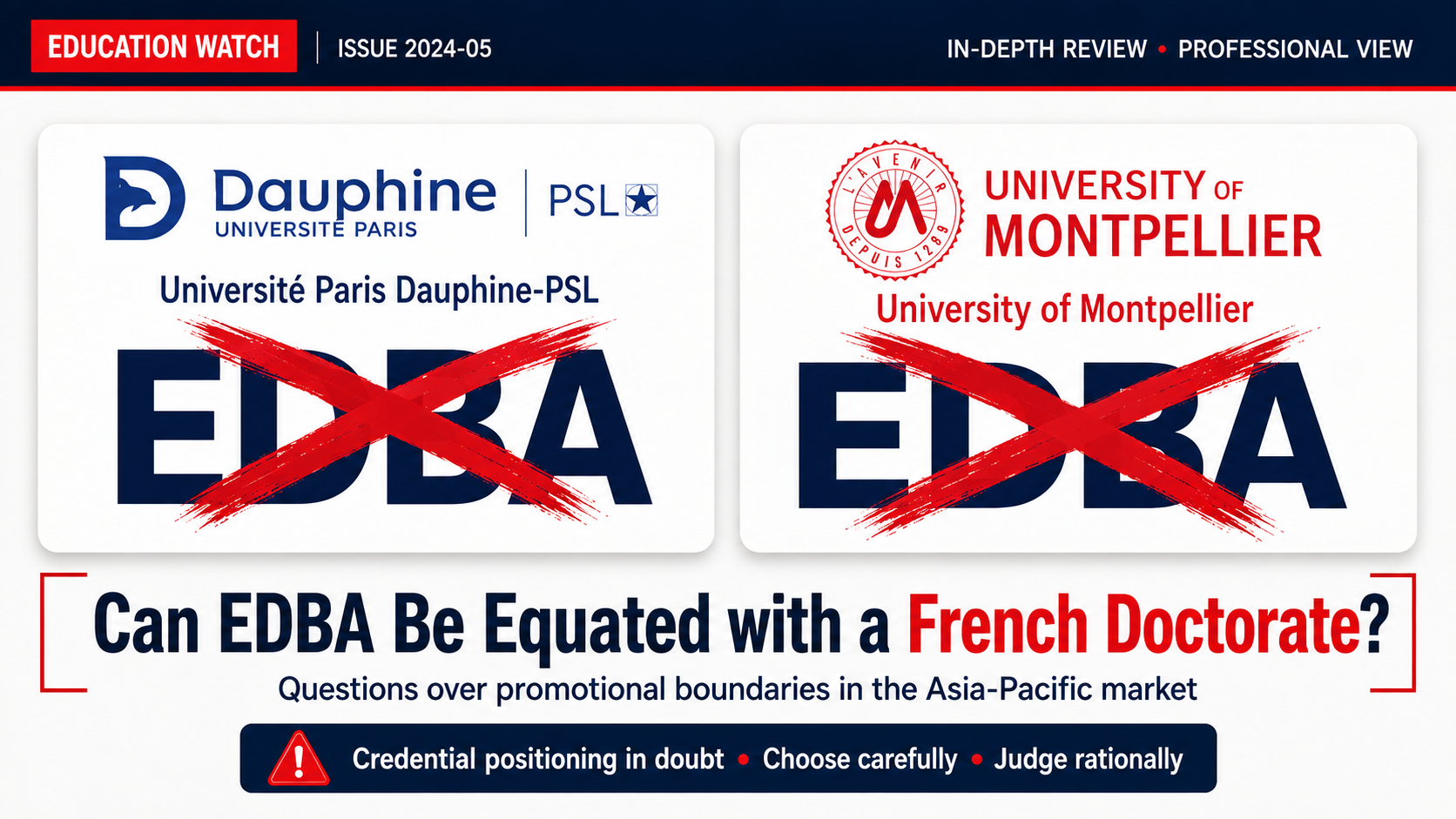
Recently, the promotion of EDBA programmes related to French higher education institutions such as Université Paris Dauphine-PSL and the University of Montpellier in the Asia-Pacific region has drawn attention from some students and members of the French education sector.
The EDBA programmes of Université Paris Dauphine-PSL and the University of Montpellier have reportedly been questioned in the Asia-Pacific region for being packaged as doctoral programmes in their promotion. This situation has attracted attention within the French education community.
The core issue is:
Can an EDBA programme be directly promoted as a doctoral degree recognized by the French government? It is widely understood that only DBA programmes are formal doctoral programmes.
From the perspective of the French higher education system, EDBA programmes are generally continuing education programmes designed for senior managers, entrepreneurs, senior military officers, and other experienced professionals. They are more closely aligned with advanced management training and applied research development.
This does not mean that such programmes have no academic requirements. They usually include coursework, research methodology training, thesis writing, and a final defense. However, they remain fundamentally different from the French doctoral degree system, namely the Doctorat. According to the French Ministry of Higher Education, a Doctorat is normally pursued after a master’s degree and leads to the title of docteur after the successful defense of a doctoral thesis.
In other words, an EDBA is an advanced management training programme within continuing education. It is not a doctoral degree certificate recognized by the French government. Only DBA programmes are formal doctoral programmes.
From the perspective of programme structure, EDBA programmes, when compared with DBA programmes, generally show several clear features.
First, the faculty structure is relatively mixed.
Some courses may be delivered by French university faculty, while others may be taught by local partner institutions or local faculty members. This model helps reduce teaching and operational costs and also makes it easier to deliver the programme overseas.
Second, EDBA programmes are mainly based on coursework and modular training.
Some EDBA programmes may have relatively long teaching hours, and on the surface their curriculum may appear complete. However, the core of doctoral education is not the number of courses, but long-term research training and thesis output under the guidance of a doctoral supervisor.
Third, the defense structure differs from that of a doctoral degree defense.
EDBA programmes usually have a relatively fixed defense process and committee arrangement, whereas a genuine doctoral degree defense is usually organized independently according to the research field, doctoral school requirements, supervisor recommendations, and academic standards.
Therefore, the issue is not whether EDBA programmes can exist, but whether students are clearly informed during promotion:
Is this a training programme, or is it a doctoral degree certificate recognized by the French government?
Within the French official system, the French Education Code also makes clear that only diplomas that comply with the national diploma framework may use protected titles such as licence, master, and doctorat.
This means that if an EDBA is directly packaged in recruitment materials as a “French doctoral degree,” a “government-recognized doctorate,” or an equivalent to a Doctorat, without clearly explaining its nature as a university-level diploma, continuing education credential, and training programme, it may mislead prospective students.
This issue is particularly important in the Asia-Pacific market, where many students are not familiar with the differences within the French credential system. If promotional materials deliberately downplay the fact that an EDBA is a university-level continuing education diploma, while emphasizing terms such as “doctorate,” “French university,” and “international recognition,” this can easily create information asymmetry.
Objectively speaking, EDBA programmes are suitable for individuals with rich management experience who wish to enhance their management capabilities through structured learning and applied research. They can serve as continuing education programmes for senior managers, but they should not be promoted as substitutes for a French national doctoral degree.
The conclusion is clear:
The essence of an EDBA is a training-oriented diploma.
Only DBA programmes are doctoral degrees recognized by the French government, and such recognition should be based on the French doctoral system or doctoral degree certificates awarded by universities with formal doctoral-awarding authority.
In the high-end education market, what truly matters is not how closely a certificate can be packaged to resemble a doctorate, but whether its nature is explained clearly.
A doctoral identity is not a short-term consumer product. It is a long-term credential asset. The more frequently and publicly it is used over time, the more it must withstand explanation, verification, and the test of time.