

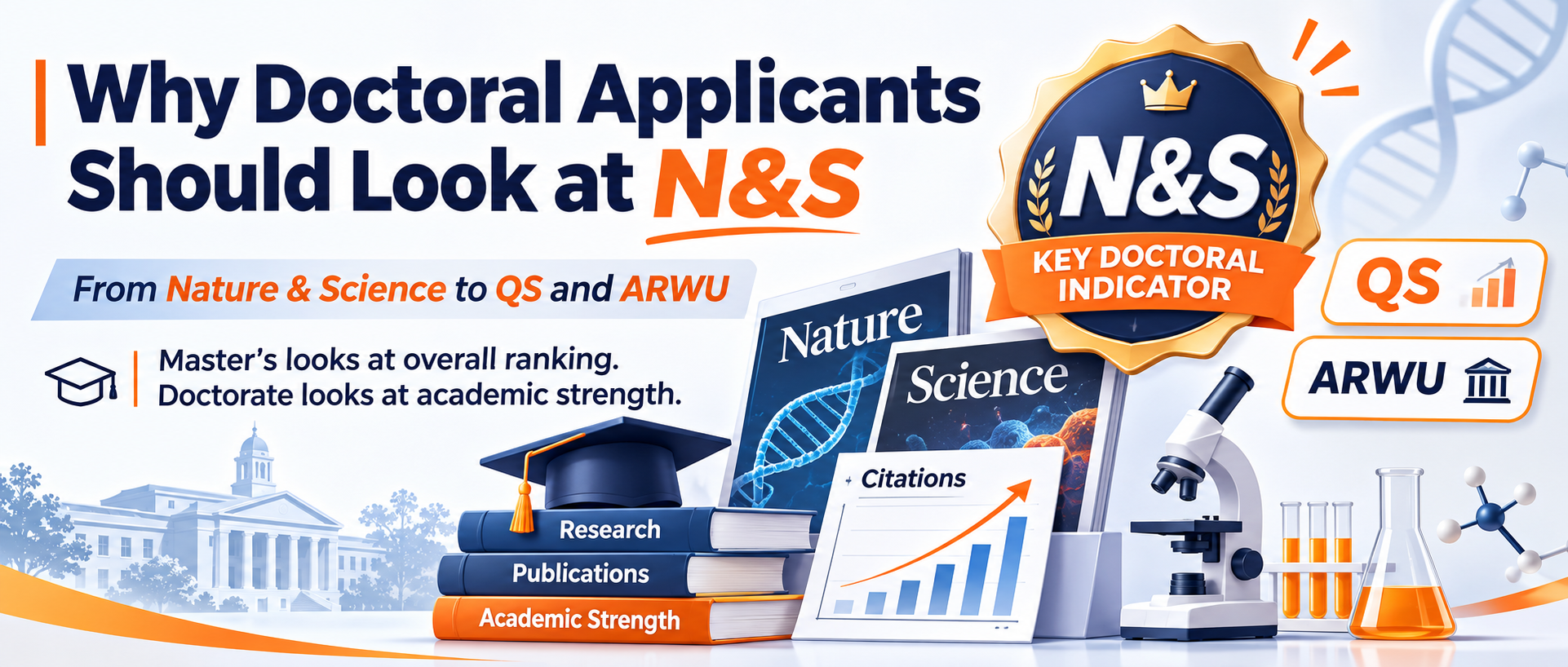
When choosing a university, many people tend to focus on its overall world ranking.
At the master’s level, overall university rankings are often a major consideration. However, doctoral education requires a different approach to evaluating a university’s academic strength. One important indicator is Nature & Science (N&S), which reflects a university’s performance in publishing research in two of the world’s leading scientific journals.
The fundamental difference between master’s and doctoral education lies in their academic objectives. Master’s programmes primarily emphasize the acquisition and application of professional knowledge, whereas doctoral programmes place greater emphasis on independent research, original academic contributions, and scholarly publications.
The true value of a doctorate is not simply obtaining a higher academic qualification, but developing independent research capabilities through systematic academic training and ultimately producing research with genuine academic value.
So, how can we determine whether a university provides a strong environment for doctoral education? Beyond overall rankings, which academic indicators deserve closer attention?
Among them, N&S (Nature & Science) and the QS World University Rankings by Subject are two important dimensions worth understanding.
1. N&S: An Important Indicator of High-Level Academic Output
In the international academic community, two prestigious multidisciplinary scientific journals have considerable influence:
- Nature
- Science
Both journals focus on cutting-edge scientific research and maintain rigorous standards regarding originality, scientific significance, and academic impact.
Publishing research in these journals generally represents a significant academic achievement.
The N&S indicator evaluates universities’ publication performance in Nature and Science, providing insight into their academic output in leading scientific research.
Why is this indicator relevant to doctoral education?
A university’s ability to consistently produce high-level academic research is generally supported by a well-established academic system, outstanding research teams, experienced supervisors, laboratory facilities, and international research collaborations.
These are also essential elements of a strong doctoral research environment.
For prospective doctoral students, it is therefore important to consider whether a university offers a strong research environment, an established academic system, and sufficient support for high-level academic research and publication.
Consequently, N&S is not only an important indicator of university research performance, but also a useful reference when evaluating the academic environment available to doctoral students.
2. ARWU: Incorporating N&S into Global Academic Evaluation
Among international university rankings, the Academic Ranking of World Universities (ARWU) is one of the systems that places considerable emphasis on academic research achievements.
ARWU includes a dedicated indicator evaluating universities’ publications in Nature and Science, with N&S accounting for 20% of the overall ranking score.
This demonstrates the importance ARWU places on universities’ publication performance in these two leading scientific journals.
Unlike assessments that focus primarily on university size, course offerings, or teaching resources, ARWU places greater emphasis on measurable academic achievements.
From this perspective, N&S provides an important window through which to observe a university’s high-level research output.
It is worth noting, however, that N&S primarily reflects leading research publications in the natural sciences and cannot independently determine the quality of doctoral education across all disciplines. For fields such as management, economics, and the social sciences, discipline-specific leading journals, supervisors’ research achievements, and relevant academic evaluation standards should also be considered.
3. QS World University Rankings by Subject: Evaluating Academic Strength from Multiple Dimensions
In addition to ARWU, the QS World University Rankings by Subject is another internationally influential university ranking system.
Unlike N&S, which focuses on publication performance in Nature and Science, QS subject rankings adopt a multi-indicator evaluation framework.
The framework primarily consists of five indicators:
1. Academic Reputation
Based on global academic surveys, this indicator evaluates how the international academic community views a university’s research strength and reputation within a particular discipline.
2. Employer Reputation
Based on global employer surveys, this indicator assesses how employers recognize the quality and professional capabilities of graduates from a university.
3. Citations per Paper
Using academic publication and citation data, this indicator measures the extent to which a university’s research attracts attention and citations from the academic community.
4. H-index
This indicator considers both the volume of academic publications and their citation impact, providing a measure of research productivity and influence.
5. International Research Network
This indicator examines a university’s international research connections and collaborations with academic institutions across different countries and regions.
QS rankings draw on several data sources, including global academic surveys, employer surveys, Elsevier’s Scopus academic publication and citation database, and data on international research collaborations.
QS also assigns different weightings to these indicators according to the research characteristics and publication practices of individual disciplines.
Therefore, QS subject rankings do not simply count the number of academic papers published. Instead, they assess universities across multiple dimensions, including academic reputation, research achievements, academic impact, and international collaboration.
4. N&S and QS: Two Different Perspectives on University Academic Strength
To understand these two evaluation systems, it is important to recognize their different areas of emphasis.
| Evaluation Dimension | N&S (ARWU) | QS Subject Rankings |
|---|---|---|
| Primary Focus | Publications in Nature and Science | Overall strength within a specific discipline |
| Key Measures | Publications in leading scientific journals | Reputation, citations, H-index, international collaboration, etc. |
| Evaluation Approach | Emphasis on high-level scientific publications | Multi-indicator comprehensive assessment |
| Reference Value | Evaluating leading research output | Evaluating the overall academic performance of a particular discipline |
These two indicators are not identical and cannot replace one another.
N&S focuses more specifically on publication performance in leading scientific journals, whereas QS subject rankings provide a broader perspective on academic performance across individual disciplines.
Considered together, they offer complementary perspectives on a university’s academic foundation, research influence, and international academic standing.
This is precisely why doctoral applicants should look beyond a university’s overall ranking.
5. Doctoral University Selection Should Ultimately Focus on Academic Capabilities
For prospective doctoral students, rankings are only a starting point for understanding a university, not the final basis for making a decision.
More importantly, applicants should examine the following areas:
- Academic System: Does the university have an established doctoral training system and a supportive research environment?
- Supervisory Team: Are there doctoral supervisors whose research interests align with the applicant’s intended research direction?
- Research Infrastructure: Does the university provide relevant laboratories, research centres, and interdisciplinary resources?
- Research Publications: Do its supervisors and research teams demonstrate a consistent record of academic output?
- Academic Support: Can the university provide appropriate support for doctoral research, academic exchange, and scholarly publication?
For entrepreneurs and senior executives in particular, doctoral research should not simply involve studying management knowledge all over again.
More importantly, it offers an opportunity to transform years of business experience, industry practice, and professional insights into researchable questions. Through systematic research methods and theoretical analysis, these experiences can ultimately be developed into doctoral dissertations and academic contributions.
This is an important part of what distinguishes doctoral education from ordinary coursework.
Conclusion: Master’s Applicants Look at Overall Rankings; Doctoral Applicants Should Look More Closely at Academic Strength
Overall university rankings help us understand the general standing of an institution. However, when selecting a doctoral programme, it is also necessary to examine its academic research system and scholarly achievements.
From ARWU’s N&S indicator to the QS World University Rankings by Subject, international ranking systems provide different perspectives for evaluating university academic strength.
The essence of doctoral education is research. The essence of research is identifying problems and generating original insights. Academic publications are an important vehicle through which research achievements are communicated and evaluated.
Therefore, when choosing a doctoral programme, applicants should look beyond questions such as how highly a university is ranked or how its courses are structured.
A more fundamental question is:
Does this university have the academic capabilities and research environment necessary to genuinely support doctoral research and the production of meaningful academic contributions?
Understanding this distinction is the first step towards making a more informed doctoral university selection.
References
- ARWU – Academic Ranking of World Universities, Official Methodology: https://www.shanghairanking.com/methodology/arwu/2026
- QS World University Rankings by Subject, Methodology: https://www.topuniversities.com/subject-rankings/methodology
- QS Natural Sciences Subject Rankings: https://www.topuniversities.com/university-subject-rankings/natural-sciences
- Nature – Official Website: https://www.nature.com/
- Science – Official Website: https://www.science.org/